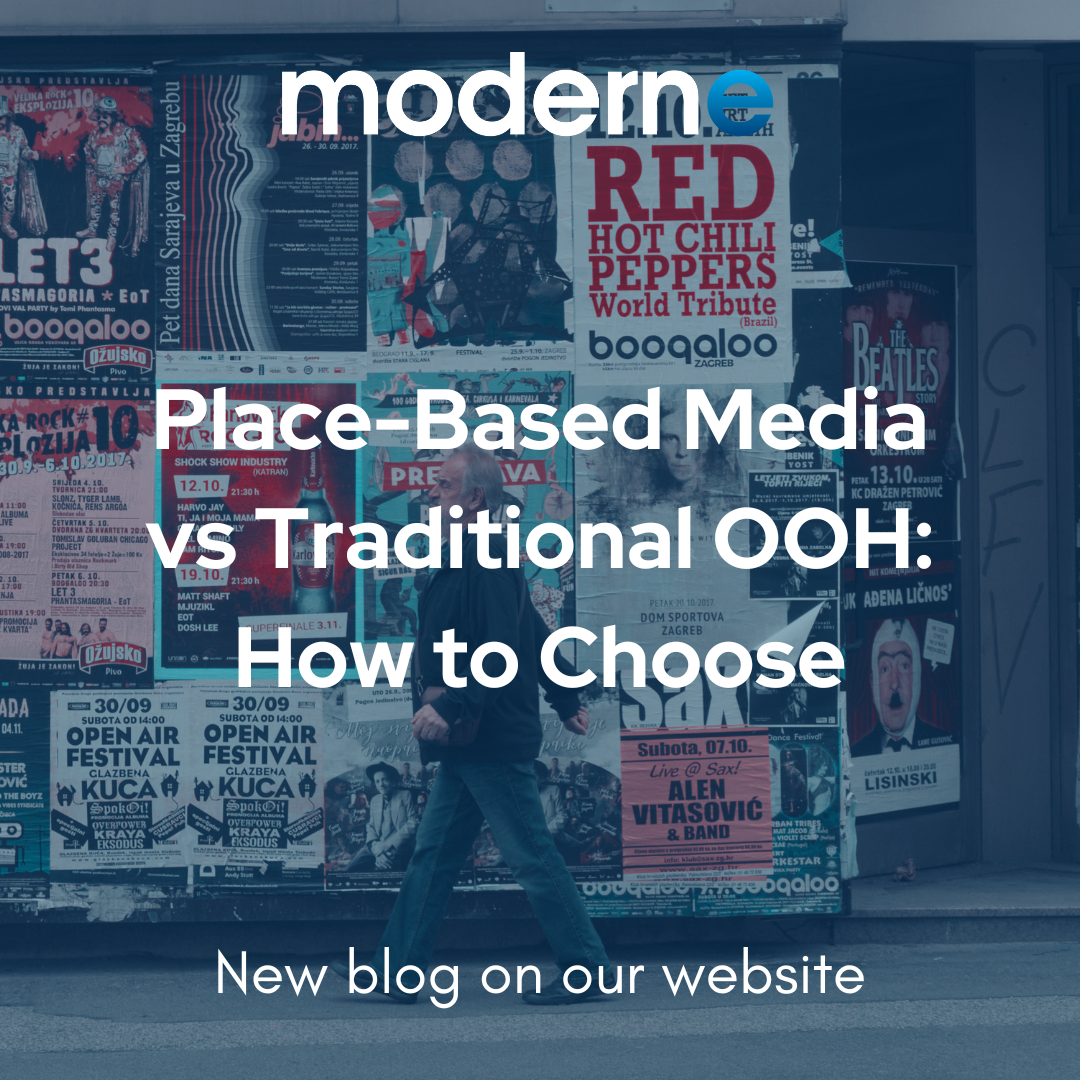
What is place-based media compared to traditional OOH?
Place-based media is out-of-home advertising placed inside real-world venues people already visit, like barbershops, salons, supermarkets, and clinics, while traditional OOH focuses on large, high-visibility formats such as billboards, bus shelters, and transit ads that reach broad audiences moving through public spaces.
In practice, this means a very different canvas. Place-based media uses interior posters, mirror clings, shelf talkers, and digital screens inside locations where people wait, browse, or check out. Traditional OOH usually lives along highways, major corridors, and city streets where the priority is maximum reach and size rather than environment-level nuance. A highway billboard might be seen by hundreds of thousands of drivers, while a poster inside 200 neighborhood salons reaches a smaller but more specific audience in an intimate setting.
This difference in environment changes how people interact with your message. Place-based media catches people in dwell-time moments like waiting for a haircut, sitting in a lobby, or standing in a checkout line, so they can actually read, absorb, and respond. Traditional OOH often relies on quick, high-frequency exposures at speed. Both sit under the same OOH umbrella, but place-based executions are more granular, venue-led, and community-rooted.
Key differences in targeting, context, and measurement
Place-based media excels at hyper-local, audience-first targeting. You start by defining who you need to reach, small business owners, parents, multicultural communities, and then map that profile to specific zip codes and venue types that match daily routines. Instead of buying “greater metro,” you might target 250 barbershops, salons, and corner stores in key neighborhoods to reach your audience where they already gather.
Traditional OOH typically buys reach: highways, major intersections, bus routes, or subway stations that deliver mass impressions. This is powerful for awareness, especially for big brand launches or citywide campaigns, but it can be less efficient when your goals are localized, like driving grant applications in a single county or promoting services to a specific cultural community.
Measurement is another major difference. Place-based programs routinely integrate QR codes, short URLs, and dynamic landing pages so every poster or in-venue display has a trackable call to action. Research cited by Scanova shows that OOH combined with QR codes can increase ad awareness by up to 200%, turning static prints into performance media. Traditional OOH increasingly offers similar tools, but much of its value is still reported via modeled impressions and brand-lift studies rather than direct actions like scans, signups, or redemptions.
When to choose place-based media vs traditional OOH
Choose place-based media when you need precision: reaching defined communities, driving specific actions, or building credibility in neighborhoods where trust matters. Public sector and nonprofit campaigns, multicultural outreach, and local launches benefit from being inside everyday venues where messages feel like part of the community rather than an outside voice shouting from a billboard. For example, a countywide small business grant program that placed posters in nearly 250 local venues drove thousands of applications and helped unlock more than $50 million for entrepreneurs.
Traditional OOH is the better choice when your priority is broad, rapid reach, for example, announcing a new product statewide, building brand fame, or supporting a national campaign with high-impact visuals. Large-format digital OOH can capture up to 5× more attention than standard online formats, and DOOH is projected to surpass $25 billion by 2030 according to StackAdapt. In many cases, the strongest approach is not either/or but both: use billboards and transit for top-of-funnel awareness, then layer place-based media in specific zip codes to turn that attention into measurable action.
Not sure which format is right for your campaign? We'll help you figure it out. Schedule a conversation with our team to learn more.